Becoming Inhabitants
After seventeen years, the Turtle Island Bioregional Congress reconvenes.

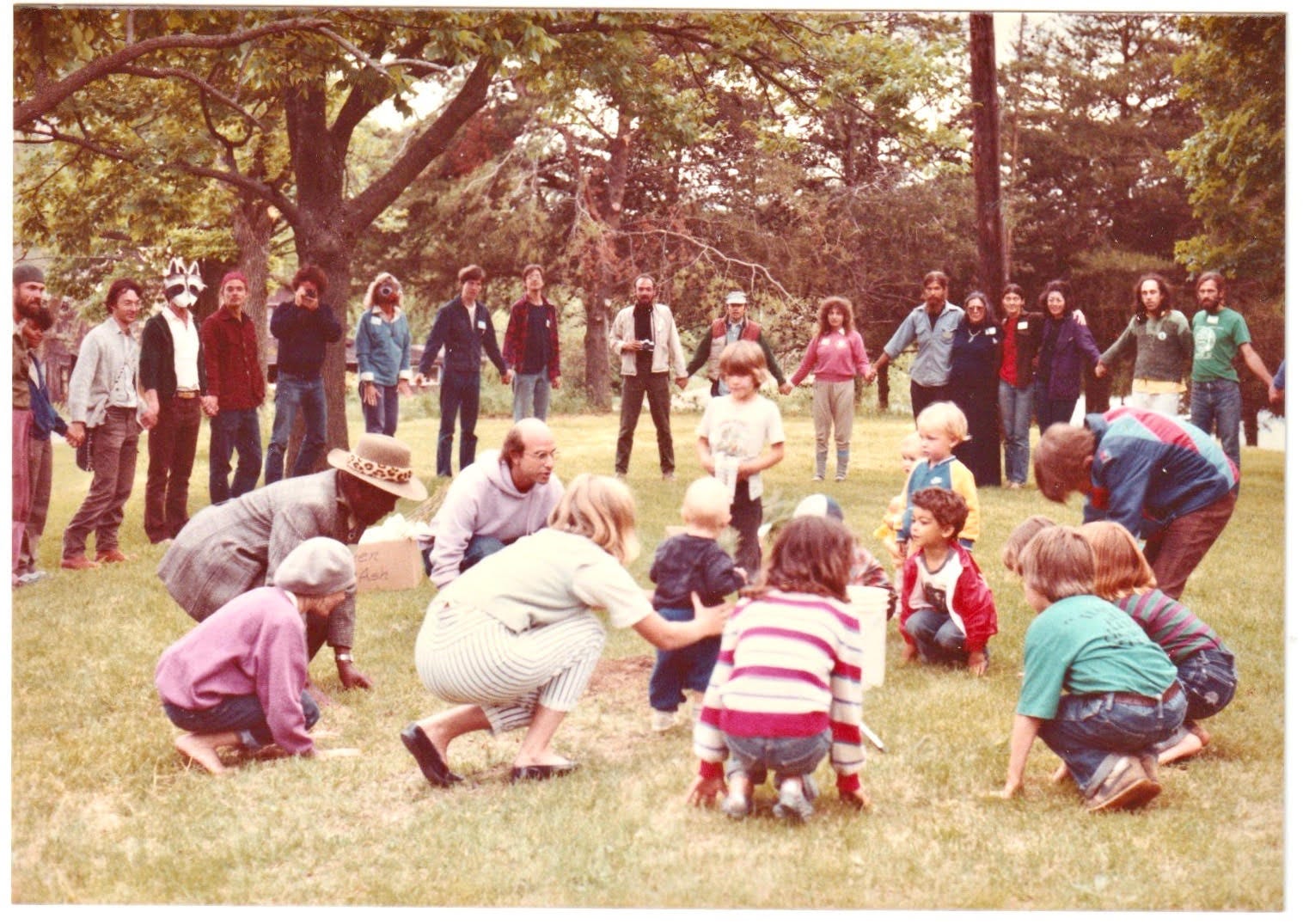
“Everything is getting better and better and worse and worse, faster and faster,” says David Haenke. He’s talking to me over Zoom from his beloved Ozark Mountains, where he’s lived since 1971. In 1984 David organized the North American Bioregional Congress, the first attempt to organize a continent under the banner of bioregionalism: the idea that culture and economy can be built on the ecological boundaries of a place – its watersheds and foodsheds, rather than its political lines. Nine more continental Congresses followed over the next quarter-century, the last in 2009. This September, after seventeen years, the Turtle Island Bioregional Congress convenes in Oregon, and David will be there.
As the Congress delegates gather, how are we to understand David’s analysis? Starting with the worse and worse, seven of the nine planetary boundaries, the limits within which Earth remains safely habitable, have already been crossed. The choking of the Strait of Hormuz has made clear how completely the global economy runs on fossil fuels, and how unevenly supply shocks land: gas prices blip at the American pump while people in Mumbai and Manila queue before dawn for cooking-gas cylinders they can no longer afford. Simultaneously, the AI race is concentrating capital and power in ever fewer hands.
But the better and better is real too. Anxiety about AI displacement, the cost of living, and wealth inequality is producing real common ground across the political aisle. And the same technologies concentrating power at the top are also bringing greater agency to the edges. It has never been cheaper to gather data, reach out to communities, and build organizations outside of inherited institutions.
The better and worse are compounding: the current crises feed each other faster than institutions can respond; simultaneously the tools for building alternatives spread faster than anyone can map. Both curves are steepening at once. So the question I’m bringing to David and to this year’s Congress is simple: can bioregional organizing mature from a loose coalition of scattered experiments into a movement that can move resources, coordinate action, and sustain communities through what’s coming? Over the past several months I spoke one-on-one with the Congress organizers – Karie Crisp, Clare Brodeur, Lilly Falconer, Brandon Letsinger, and Bill Baue – to understand what they’re building and why it matters.
A Partial History of Bioregionalism
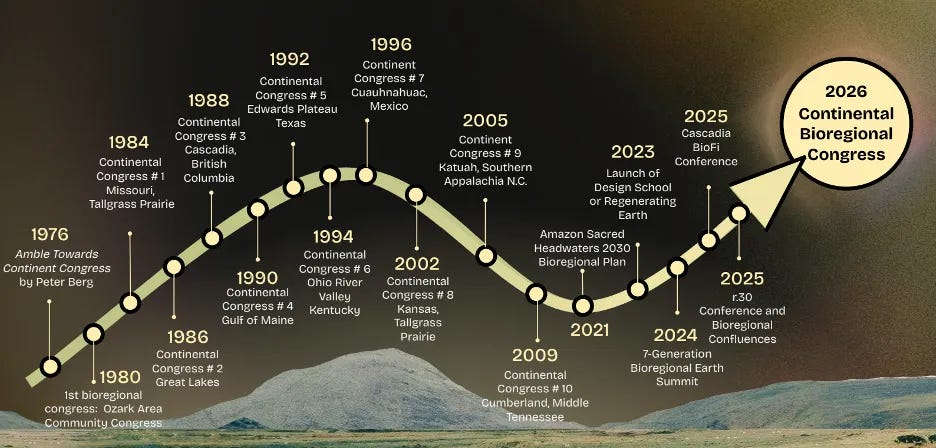
There is no definitive history of bioregionalism; what follows draws on the version assembled in Karie Crisp’s introduction to the movement’s history. Karie is completing a PhD on the movement’s history and has spent countless days in its archives with Lilly Falconer. The idea of reconvening the Congress emerged a year and a half ago in conversations between her, Samantha Power, and David Haenke; Karie has led the effort since. With award-winning filmmaker Louis Fox, Karie also executive-produced and co-wrote The Future is Bioregional, a moving short film that situates the Congress within the history of the movement.
The first era of bioregionalism, beginning in the mid-1970s, laid the movement’s foundations. Its early organizers grew out of 1960s counterculture and the back-to-the-land movement, people disillusioned with industrial modernity searching for a more rooted relationship to place. In 1976, the year of the U.S. Bicentennial, Peter Berg published the Amble Toward Continent Congress, calling for settlers of North America to “finally become inhabitants and find out where they are,” and to transfer their “loyalty from the state which violates it to the region which requires it.”
Indigenous nations and BIPOC organizers were present and shaping the Congresses from the start, not as invited guests but as co-authors of the movement’s commitments, beginning with the first Congress’s opening resolution on treaty and sovereignty rights. And women have anchored the work across every era: Caroline Estes facilitated the first Congress and was widely credited for its success, and figures like Winona LaDuke and Charlene Spretnak carried the work forward across decades. That lineage continues in the women organizing this Congress: Karie Crisp, Clare Brodeur, and Lilly Falconer.
Real institutions grew out of this first era: the first Congress’s Green Movement Committee helped seed the U.S. Green Party, while the Ozark Land Trust, which grew out of the Ozark congresses, now protects more than 32,000 acres across Missouri and Arkansas. For years the Congresses sustained themselves on modest budgets and volunteers. The tenth Congress convened in 2009. Afterwards, money was tight, and a coordinating council spent years trying to mount an eleventh; it could not. The Congress went quiet, but the movement continued in home bioregions across the continent under other banners.
The second era of bioregionalism, the one we are in now, is driven by a hardening awareness that mainstream institutions are incapable of addressing spiraling social-ecological collapse; it is also boosted by a slew of digital tools for organizing people, information, and money. An ecosystem of organizations has emerged whose explicit purpose is not just to practice bioregionalism locally but to connect those practicing it globally through participatory governance tools, learning pathways for practitioners, and financial mechanisms. Earlier bioregional efforts, for all their reach, never had this. Hylo, a platform built for place-based organizing, is a good example of such a tool. Much of the Congress’s coordination and community-building runs on it, and one of the Congress organizers, Clare Brodeur, is its Director of Product.
Bright Spots, Planetary Disease
While the contours of a second era of bioregionalism are becoming visible, they are still far from fully formed. When people ask me for tangible evidence of what the bioregional movement has accomplished, I panic slightly because I cannot point to a mature, functioning bioregional system, one that can serve as proof to the world that we can indeed design place-based economic-cultural systems that can effectively counter the pressures of the extractive economy. What exists instead are what David calls “bright spots trying to heal a planetary disease.”
I can point to watershed councils, community land trusts, locally-stewarded forests, revolving loan funds, and food sovereignty networks across the Global North; across the Global South, there are traditional and Indigenous economies that have never stopped being bioregional in practice, despite the encroachment of extractive industry. Paul Hawken has called this the largest social movement in human history: thousands of organizations working on ecological and social regeneration, so diffuse and locally rooted that no single institution can claim it. The change, and the continuation, is patient and place-specific by design.
But the movement remains scattered. The connective tissue of shared infrastructure, finance, and narrative is still forming and finding its appropriate function. This is why the BioFi Project focuses most of its energy on a small number of bioregional initiatives that we believe can become genuine proof points – bioregions capable of economic transformation beyond just supporting a collection of place-based projects. We also reserve some of our energy for the complementary, more nebulous work of tending to the global movement through storytelling, knowledge generation, weaving, and online community building.
Networks & Money
Two challenges stand out at this juncture.
First, networks. What exists on the ground is pockets of people engaged in bioregional organizing: some more homogeneous, some deeply diverse, but none of them yet woven into densely networked, place-based coalitions, broad and representative of the people and more-than-human life in the bioregion. The task is to weave these pockets into place-based coalitions of solidarity. The Congress is designed with this in mind: organizers have released tickets progressively, monitoring geographic and demographic representation, with scholarship funds, free tickets, and stipends to reduce barriers. Delegations are forming from Hawaii, Alabama’s Black regenerative farming networks, Central America, Canada, and First Nations local to the site, including the Yakama, Grand Ronde, and various Salish Sea nations.
Building such coalitions may be easier than it looks. Bioregionalism is often read as a project of the left, but a recent ethnographic study of conservative Americans by the SNF Agora Institute at Johns Hopkins and ReD Associates found that one of the values these communities remain most committed to is place: the conviction that we all belong to particular communities and landscapes that distant institutions have no right to remake. They also favor governance close to home and hands-on self-reliance – growing their own food, distrusting fragile supply chains, leaning on neighbors rather than agencies.
Real disagreements between left and right remain across culture, politics, and economics. But there is broad agreement about the shape of the life people want: rooted, human-scale, self-reliant, wary of distant institutions. At that level, bioregionalism is less an ideology than a description of something many people across the political spectrum are already reaching for under other names. It’s this recognition that leads Daniel Christian Wahl, author of Designing Regenerative Cultures, to suggest that bioregionalism is not a movement at all, but the reemergence of an old pattern: lives organized around the ecological realities of the places people inhabit.
The work of weaving, identity-building, convening, and relationship-tending is precisely the work that is hardest to fund. As Congress organizer Brandon Letsinger, Executive Director of the Cascadia Department of Bioregion, puts it: “People are doing the work. But they’re burned out. They’re isolated. They’re not being supported.”
Which leads us to the second major challenge: money, for projects on the ground, networks within bioregions, networks across continents, and the global bioregional movement as a whole. Traditional philanthropy rewards individual organizations over collective infrastructure and easy-to-measure outcomes over more diffuse results that are difficult to quantify and take time to accrue. For regenerative enterprises, conventional investment models are built around short-term financial returns and a very narrow perception of what risk is. Neither suits the patient, place-specific, whole systems work of bioregional economic transformation. The result is a movement whose practitioners are attempting to build something durable without a durable floor beneath them: funding shifts without warning, and the relational groundwork bioregional organizing depends on crumbles as a result.
The two challenges, networks and money, are connected. Work on the ground, done by and with the communities that share a landscape, earns a movement its legitimacy; legitimacy, in turn, can earn trust, and trust can bring funding. And what needs funding is not just the projects but the connective tissue between them: the slow work of weaving pockets into a coalition.
Congress as Verb
So how does this year’s Congress reflect the movement’s history, and meet the two challenges of networks and money? The design of the event draws heavily from Karie and Lilly’s deep dive into the proceedings, recordings, and publications of earlier Congresses. Lilly transcribed tapes from the first Congress, held in 1984, the year she was born. “They were talking about so many of the same things we’re working with right now,” she told me. “It kind of broke my heart how little progress we’ve made.” Yet the tapes also held a legacy, she said: the efforts of the thoughtful, committed people who had been at this work for decades before her. Elders will participate in the Congress alongside organizers new to the movement: in Lilly’s words, a passing of the ember from the older generation who have kept it alight for all these decades to those who will carry it next.
Part of what makes this gathering unusual is who it’s for. Bioregionalism offers a platform broad enough to host conversations about Indigenous sovereignty, regenerative agriculture, watershed governance, local finance, food systems, and democratic renewal. The Congress is designed not as a gathering of card-carrying bioregionalists, but as a space where people can find common ground in the biocultural realities of the places they inhabit. As Clare Brodeur puts it: “This is for anyone working on thriving futures for humans in balance with our ecosystems.”
When I asked the organizers how this big-tent invitation shaped the design of the Congress, they all separately responded with a grammatical insistence: congress is a verb, not a noun. Participants are not conference attendees. They are delegates, accountable to the communities and landscapes they come from, with a responsibility to carry something back. And the Congress is deliberately small, capped at 300 people, to ensure relationship-building across the movement’s many scattered threads.
Mornings pair randomized talking circles with a parallel track of workshops and skill-sharing sessions; veterans of the earlier Congresses found the circles invaluable for building relationships across bioregions. Evenings bring panel dialogues: Indigenous voices, discussions of finance and funding, showcases of organizing technology. The final day is reserved for Congress deliberations, which will be less formalized than the resolution process of the early Congresses. The output will be a Bioregional Action Plan, a menu of concrete strategic commitments – ranging from rights of nature to bioregional finance to watershed governance – that Congress participants can opt into. Delegates choose which of these commitments to make and implement based on what’s most relevant to their home bioregion, leaving with both a practical implementation guide and a continent-wide cohort working on the same priorities. The proceedings will also be documented in Voice of the Turtle, the tradition of daily artisan journalism established during the early Congresses.
The Congress is also one node in something larger. Bill Baue, who came to bioregionalism through the ecological thresholds work in the lineage of systems-thinking pioneer Donella Meadows and now leads global convening at r3.0, brings an explicitly international framing. The week before the Congress, r3.0 will host its own global bioregional convening, digital and accessible from anywhere. The week after the Congress, many engaged in bioregional work in North America will be gathering for New York Climate Week, an opportunity for those on the ground doing the work of regeneration to engage with funders, technologists, legal counsel, and other enablers for their work. The same week, the Design School for Regenerating Earth will host the first Mediterranean Bioregional Activation in Tunisia. Similar gatherings are being organized in Asia and Australia. September 2026 is being framed as a Global Bioregional Month, a distributed movement pulse rather than a single event; r3.0 is tracking the full calendar.
For the BioFi Project, the Congress is an invitation to build bridges between people otherwise working in isolation: those mapping and sensemaking in their bioregions, those developing governance and co-ownership structures, those defending their places from extractive interests, and those running economic and financial experiments. Bioregional transformation requires all of these, and we hope the gathering surfaces the full range of tools for catalyzing it amid the deepening metacrisis. We believe bioregional finance is an important part of that picture. We want delegates to come away seeing Bioregional Financing Facilities as important structures that, once formed, can support the return of capital to the places from which it has been extracted. We hope delegates can see opportunities afforded by the range of tools and approaches available for engaging in economic transformation, including BFFs, bioregional and gift economy hubs, mutual credit and alternative currency systems, eco-credits, legal structures for sovereign land, and cooperative ownership structures. To the delegations carrying that work home, we offer a Community of Practice already exploring these questions together across bioregions, and a growing library of case studies and design guides, free to use and adapt.

One of a Million Worlds
All of this organizing assumes a bioregional future is within reach. Is it? A team at the Cascade Institute set out to model where our tangled global systems are likely to end up. Most forecasting looks at one system at a time, and misses how each system both enables and limits the others. Cascade’s Polycrisis Core Model treats the planet as a system of systems, offering what its makers call a “roadmap through complexity”: a way to see which futures hold together, and which fall apart.
The team fed in thousands of expert judgments about how eleven global systems push and pull on each other, then modeled millions of versions of the world in 2040. Almost all of the modeled scenarios collapsed into three stable patterns. Two are grim: “Illiberal Decline,” which pulls in the largest share by far, a world of authoritarianism, inequality, and environmental degradation; and “Mad Max,” thoroughgoing collapse. The third is rare but, once reached, just as stable: strong democracy, competent governance, economic equality, declining environmental impact.
The bioregional Congress feels to me like a design intervention aimed at that third outcome. Against the pull toward collapse, it builds local resilience: food systems, watershed governance, community economies with limited dependence on fragile supply chains and the political decisions of the nation-state. Against the pull toward authoritarianism, it distributes power downward, organizing governance around the ecological and social realities of place rather than concentrating it in distant institutions. The instinct is spreading: the incoming British Prime Minister has made decentralizing power his first major policy commitment.
It should be noted, though, that bioregionalism is not the only path. “Every ism creates a schism,” says the ecologist Satish Kumar. Many organized movements walk toward the same future with a different vocabulary: circular economy, commons governance, localism, food sovereignty, transition towns, and Indigenous sovereignty. What bioregionalism does well, however, is to take a whole-systems approach to ecology, culture, economy, and politics at once, resisting the siloing that plagues most movements. It has common threads to weave with movements walking other paths – Indigenous economic restoration among them. That capacity to invite coherence without demanding uniformity might be its most underrated gift.
Fifty years after Peter Berg’s invitation to “congress,” the bioregional inquiry has sharpened: whether we can become true inhabitants of our landscapes, rather than occupants, consumers, or displaced persons passing through, is no longer a philosophical question. With ecological and climatological systems rapidly collapsing, cheap energy fading, the human body of knowledge extracted and enclosed for profit, and nation-state stability visibly fraying around the world, it is a practical one.
The forces bioregionalists like David Haenke were naming in the 1970s – the concentration of power, the extraction of ecological wealth, the substitution of consumption for community – have accelerated and become more visible. The margin for error is now much narrower. But David’s answer has not changed: “Take direct instruction from the natural world. When you do so, you’ll see that the bioregional is the natural unit for place-based regeneration.” In a moment of bewildering complexity, that feels like a simple and powerfully personal place to start.
Félix de Rosen is a member of the BioFi Project team. For this article, he interviewed Karie Crisp, Clare Brodeur, Lilly Falconer, Brandon Letsinger, Bill Baue, and David Haenke. All provided feedback on the article. This article was edited by Samantha Power and Nick Paul of the BioFi Project. The Turtle Island Bioregional Congress takes place September 15-19, 2026, in Vernonia, Oregon, on Chinook traditional land; the BioFi Project team will be present.
Thank you for this extremely thoughtful overview of the current and past bioregional movements. I especially appreciated your emphasis on relationships, connective infrastructure, and weaving rather than simply launching more projects. That resonates deeply with my own experience.
One question I've been wrestling with for nearly forty years is whether the next challenge is not simply connecting bioregional initiatives, but understanding the scale at which those relationships naturally emerge.
In my experience, ecovillages are often too small to become the organizing center of a region, while an entire bioregion is often too large and diverse for people to experience as a genuine community.
The most fertile scale seems to be what I think of as the micro-bioregion (a term Joe Brewer and I discussed on Twitter years back)—municipalities, counties, and clusters of neighboring towns.
That's where people already know one another, attend schools and congregations, support local businesses, volunteer, and solve problems together. It seems like the natural level at which broader bioregional networks can actually take root.
A second thought concerns language. Every movement develops its own vocabulary, and that vocabulary gives it identity and coherence.
But it can also unintentionally narrow its invitation.
I wonder whether terms like bioregionalism naturally resonate with people who are already committed to ecological and regenerative worldviews, while many others who share the same underlying values never recognize themselves in the invitation.
That raises an interesting question for me: What is the broad civic language that can welcome farmers, churches, businesses, neighborhood associations, Indigenous communities, schools, conservation groups, and local government into the same conversation without asking them to first become "bioregionalists"?
It seems to me that one of the next frontiers may not simply be building stronger bioregional networks, but developing a larger, more inclusive container that allows many different expressions of place-based regeneration to recognize themselves as part of the same emerging story.
thank you each